Cat Litter Alternatives: What Can I Use Instead of Cat Litter?
For a planned switch, compare purpose-made pine, tofu, corn, walnut, and paper litters by format and dated cost, then keep only what your cat actually uses.
| Raw material / format | Cost | Clumping | Dust | Cat acceptance |
|---|---|---|---|---|
| Pine pellets | Seller listing checked Oct. 22, 2026: 40 lb, $19.99 ($0.50/lb). A separate household report dated Sep. 7, 2015 gave $6.50/40 lb at that time; historical, not today's price. | A Jan. 5, 2022 report describes wet pellets breaking down into siftable sawdust; the listing checked Oct. 22, 2026 identifies the exact product as non-clumping. | One three-cat household reported no dust issue on Jan. 5, 2022. This was not a measured category result. | A Sep. 7, 2015 household said its cat liked the pellets; other dated pine reports describe delayed use or later rejection in other homes. |
| Tofu pellets | Seller listing checked Oct. 21, 2026: Frisco, 7 lb, $15.99 ($2.29/lb). | The exact Oct. 21, 2026 listing labels this formula clumping; other formulas may differ. | No comparable dust result in the dated cases reviewed (Jul. 2, 2024–Dec. 1, 2025). | Dated cases from Jul. 2, 2024 through Dec. 1, 2025 describe continued use alongside separate scoop or cleanup limits; they do not rank acceptance against other materials. |
| Corn-based litter | No dated price snapshot in the reviewed record. | The maker labels its named Ultra Absorb corn-fiber formula clumping; formula-specific claim checked against its product page. | No comparable dust result in the dated cases reviewed. | One household reported cats preferred its formula on Sep. 4, 2024; separate dated records describe later leaving it. Those accounts do not establish cause. |
| Walnut granules or pellets | Seller listings checked Oct. 24, 2026: 26 lb non-clumping pellets, $23.99 ($0.93/lb); 26 lb clumping granules, $29.99 ($1.16/lb). | Both clumping granules and non-clumping pellets appeared in the Oct. 24, 2026 listings; check the exact formula. | Reports conflict: a Jul. 26, 2023 household found one formula less dusty than its prior clay; a Sep. 6, 2026 household found a different formula very dusty. | A Jun. 10, 2026 household reported years of use; other dated homes described tracking or stopping because of cost. These are separate homes and formulas. |
| Paper-based litter | No dated comparable product listing in the reviewed record. | Product-specific; no comparable exact-formula result was documented. | Not reported in the dated case material reviewed. | A May 26, 2025 emergency discussion suggested packing paper, but the outcome was not reported; it is not counted as a successful trial. |
| Sand or soil (emergency household substitute) | Not reported in the account. | Not reported as a measured clumping result. | Not reported. | A forum page marked “7 years ago” describes use in a supplemental tray, but does not separately document the cat's uptake. Not a recommendation or a successful acceptance result. |
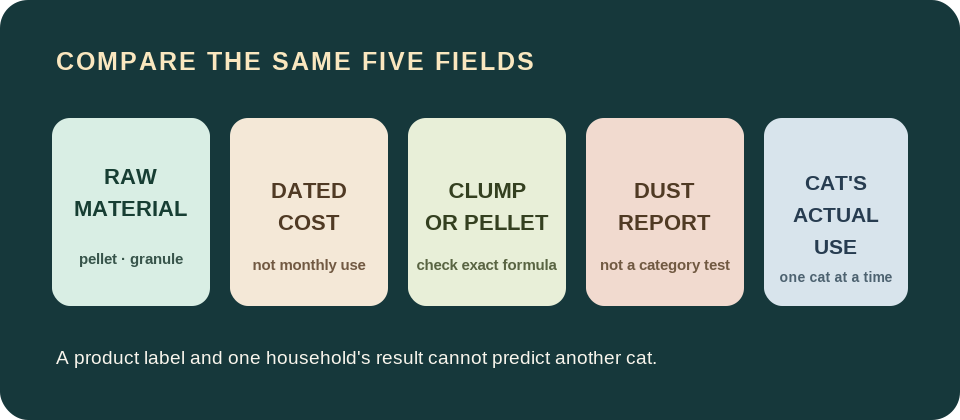
This is a comparison of dated listings and individual household reports, not a controlled test of every litter in a material category. “Not reported” means the reviewed record did not establish that result.
Prices are dated seller snapshots, not a forecast or monthly-use comparison. Individual reports do not predict another cat’s choice. Download the blank per-box litter-change record (CSV) to record material, dates, and observed results separately for each tray.
For a direct comparison of silica crystals and scoopable clay, see the crystal-versus-clay litter comparison. If the trial is for a kitten, use the kitten litter selection guide for material-specific observations and limits.
Separate an emergency shortage from a planned switch
The table compares purpose-made litter products. It does not establish that loose household materials work as routine litter, and it does not document a successful trial of packing paper. A planned replacement should be judged by the exact product and your cat's actual use.
Compare one change at a time
- Write down the exact material and product format rather than only “natural” or “plant-based.”
- If your space allows, leave the familiar litter available while observing the alternative in a separate tray.
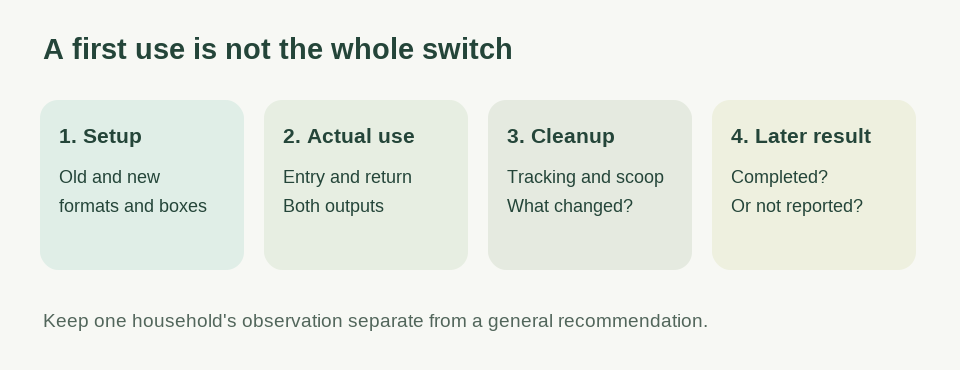
- Record entry, digging, covering, return use, visible dust, tracking, and what the scoop does with wet material. A quick sniff is not proof of ongoing acceptance.
- If the cat avoids the new tray, pause that change and restore the familiar option. A product label cannot predict the result in an individual home.
What actually happened when households changed the litter format?
Keep the familiar litter available while you check actual use and cleanup: a cat using the new material once does not establish that the new format is accepted or easier to maintain. The dated accounts below show completed switches, partial switches, and unresolved trials; none sets a universal transition period.
| Posted and owner | Format change and method | Reported outcome | Limit |
|---|---|---|---|
| 2023-01-04, Black_Kat | In a three-cat home, an earlier abrupt change from familiar clumping clay to pine pellets was followed by one cat urinating in a cardboard box; the owner later asked how to attempt a gradual change. | The later gradual trial was a question, not a reported result. | The account cannot establish why the cat urinated elsewhere, or that a slower retrial succeeded. |
| 2023-01-04, verna davies | Kept familiar litter in one tray, added a little pine to the other, topped up with pine during cleaning, then repeated for the second tray. | Reported that the cats used the first tray once it was all pine and that the household transition took about a week. | One household's reported duration does not prescribe a one-week schedule for another cat. |
| 2023-01-05, ladytimedramon | Transitioned to pine and used it for a while, then moved to crystal litter and different mats. | The cat used pine, but the owner still found pellets around the apartment and reported paw discomfort. | Use did not equal a satisfactory cleanup result; several later changes prevent attributing improvement to one item. |
| 2023-01-06, FrazzledMumbly | Put familiar litter in the front of one large box and smaller wood pieces in the back, then topped up with the new litter. | Reported eventually refilling with only the new litter. | This used small wood pieces, not a pellet formula; no exact elapsed time or controlled comparison was given. |
| 2023-01-06, wrenka | Reported an abrupt switch to pine for a cat that had not previously missed the box. | Reported that the cat continued using the box. | A successful abrupt change in this one home does not refute the different outcomes above. |
| 2023-01-12, Alldara | Offered new litter in one box while keeping other boxes familiar; reported adding a softer litter over pine for one cat. | Reported that the cat then used the pine setup and later switched remaining boxes. | The account does not isolate the softer top layer from the separate-box method; its stated one-to-two-week range is a personal report. |
| 2026-04-26, AssumptionNo3629 | Switched crystal litter directly to pine, then tried pine beneath crystal; after each attempt, kept separate crystal and pine boxes. | The owner reported urine in pine but stool outside it during both attempts. | The post does not establish a medical or behavioral cause, nor a completed successful later switch. |
Comparison inferred from these reports: verna davies and FrazzledMumbly described gradual routes that reached the new format; Black_Kat described a failed earlier abrupt attempt but did not report a finished retrial, while wrenka reported an abrupt change without a problem. The method and the outcome must therefore stay attached to each household rather than becoming a rule that every cat needs the same pace.
Second limit inferred from these reports: ladytimedramon's cat used pine yet the owner still changed materials because of tracked pellets and reported paw discomfort; AssumptionNo3629 reported urine in pine but stool outside. A single successful entry or one type of output is too narrow to certify the whole change. Record return use, both outputs, and the cleanup burden before calling the switch complete. These are observation fields, not a diagnosis or a validated medical test.
Five common alternative questions
What can I use instead of cat litter?
For a planned replacement, compare purpose-made pine, tofu, corn, walnut, or paper litter in the table above; their formats, prices, and documented household results are not interchangeable.
What can you use as cat litter?
Use the material and form on an actual cat-litter product label as your starting point; this comparison does not establish household packing materials, soil, or food products as tested substitutes.
Kitty litter substitute
A substitute can mean a purpose-made litter made from another raw material or an improvised emergency material; only the former has product-specific format and price details in this table.
Cat litter replacement
The evidence reviewed here does not establish a universal household substitute or a successful paper trial. Do not treat a suggestion without an observed result as a proven option.
Emergency cat litter
This page cannot confirm that any improvised material will be accepted or suitable in every home. The dated per-box log helps record an actual trial; it is not a safety approval or a guarantee.
For a format-specific guide to pine pellets and their cleanup trade-offs, see the pine litter comparison.
Pet health disclaimer
This content is for general information and does not constitute veterinary advice, diagnosis, or treatment. If your cat has abnormal symptoms, contact a veterinarian. Do not delay veterinary care because of something you read here.