Cat Sitting in the Litter Box? Check Output Before Changing the Setup
If your cat sits in the litter box, check urine output first: repeated attempts with little or none need emergency veterinary care. Passing urine does not explain new or persistent sitting; call your veterinarian about that change.
International Cat Care describes repeated attempts with little or no urine as an urgent warning; do not wait for a litter or box trial when that pattern appears.
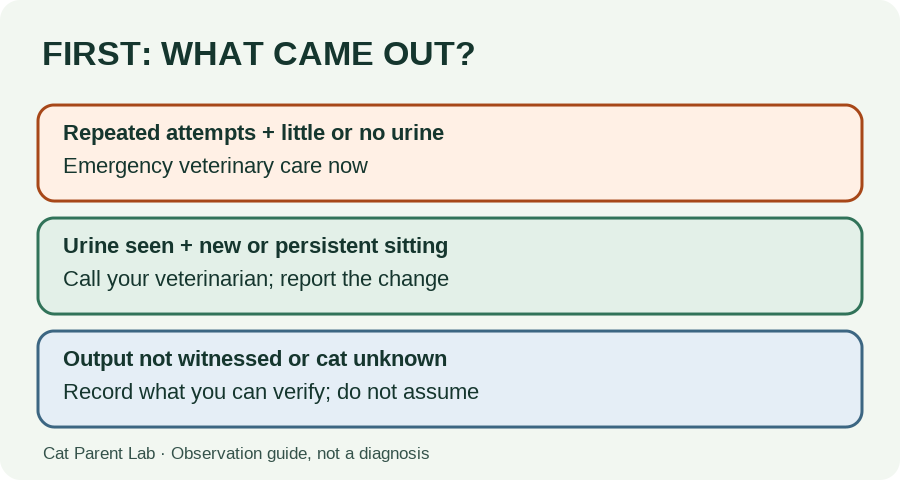
Three output paths
| What you saw | What to do |
|---|---|
| Repeated attempts with little or no urine | Seek emergency veterinary care; Cornell lists inability to urinate as an emergency. |
| You watched urine pass, but sitting is new or persists | Call your veterinarian and report the new pattern; Cornell notes that cats with a medical problem may not appear sick. |
| You found the cat resting there but did not witness output | Report what is unknown: a clump in a shared box does not identify which cat produced it or when. |
Seven dated accounts: same posture, different sequences
| Original account | Observed sequence and limit |
|---|---|
| October 4, 2026 | An older male cat remained in the box after vomiting and crying; outdoor toileting left recent output unknown, and an owner-reported emergency visit later found an IBD flare, which cannot diagnose another cat. |
| September 9, 2026 | A female cat urinated, stepped out and returned to sit; the owner reported a veterinary examination with no cause found at that visit and no later tested fix. |
| July 23, 2026 | A young male cat newly lay in the box after a clump was found; the owner removed the lid, saw him return, and reported no confirmed cause from the subsequent veterinary contact. |
| October 16, 2026 | An eight-year-old male began lying in a smaller replacement box; the owner later reported an X-ray constipation finding and improved stool output after care, while occasional lying continued, so neither the box nor the finding is a proven cause of the posture. |
| February 4, 2026 | A recently adopted adult cat repeatedly sat in the box; the owner later said she was fine and still liked sitting there, an update that cannot reassure someone else's newly sitting cat. |
| February 9, 2026 | A nearly four-year-old cat sat in or beside the box and vocalized after daily cleaning; the owner reported no clinical finding or tested correction, so cleaning is a time marker rather than a proven cause. |
| December 27, 2024 | After washing and refilling the box, an owner saw the cat lie and purr in fresh litter; without a clinical assessment or witnessed output, this report cannot establish why it happened. |
These are dated owner accounts, not controlled studies; their dates are posting dates, not verified dates of onset.
Which observation changes the next step?
The October 4 owner could not verify recent urine, while the September 9 owner watched urine pass; the identical posture therefore led to different information for a veterinary call.
The July 23 owner removed a lid yet saw the cat return, whereas the October 16 owner saw improved stool output after care but occasional sitting continued; neither a box change nor one improved output explained the posture.
The February 4 owner later reported a well cat that continued sitting, while the October 16 owner still saw sitting after a reported medical finding; neither update can be applied to a different cat without that cat's output and examination.
The February 9 and December 27 accounts put sitting near cleaning or fresh litter, but reported no tested cause; log that timing independently from witnessed urine and stool.
Keep the sequence for the veterinary call
Download the blank sitting-in-box event log (CSV); it separates witnessed urine from a clump found later and leaves cat identity or output unknown when neither was observed.
Only after urgent output concerns are addressed, record a new box, litter or location without closing off the cat's only toilet; the covered-box and lower-entry guides explain those setup checks.
The Feline Veterinary Medical Association's hospital guide notes that hospitalized cats may hide in litter boxes; that observation does not prove stress as the cause of sitting at home.
Watch the observation sequence
Evidence boundary: Urgent-care guidance comes from veterinary sources; the household comparisons cannot identify the cause of another cat's sitting or prove a change in box or litter will resolve it.