How can I clean a Litter-Robot without wetting the base?
Empty the waste drawer and remove loose litter first. Wash only parts your model identifies as washable; keep water and spray away from the powered base, control panel, and sensors. Let every washed part dry completely before reassembly. Litter-Robot models differ, so use your model’s manual for disassembly and cleaning details.
A safe cleaning sequence
- Power down and empty: keep the cat away, follow the model's shutdown instructions, empty the drawer, and remove loose litter without touching moving parts or wiring.
- Clean approved removable parts: wash the globe and drawer only as the model guide permits, then dry their seams and liners fully.
- Protect the base: use the manufacturer-approved cloth method on the controls and base; never rinse, submerge, or spray the electronics-containing area.
- Reassemble and check: reseat the dry parts, refill to the marked level, and confirm the unit reaches its normal ready state before the cat returns.
What is safe to wash?
For Litter-Robot 4, Whisker permits cleaning the removed globe but warns never to submerge, spray, or soak the base or control panel. Check the guide for your exact model before wetting any removable part; detaching it alone does not prove it is washable.
How do I clean the sensors on a Litter-Robot 4?
For the Litter-Robot 4, start by wiping the bezel with a clean, dry cloth, then vacuum its inner perimeter with a brush attachment. If debris remains in the sensor openings, Whisker’s deeper-cleaning instructions call for removing the globe, bonnet, and drawer, leaning the unit back, and gently cleaning the sensor surfaces with a clean, dry cotton swab or clearing the openings with compressed air. Reassemble the unit and run the manufacturer’s test cycle; these steps are specific to Litter-Robot 4, so use the matching guide for another model. Read Whisker’s Litter-Robot 4 sensor-cleaning instructions.
Watch the Litter-Robot 4 sensor-cleaning steps
Watch the Litter-Robot 4 sensor-cleaning Short.
When a quick clean is enough
Between deeper cleans, empty the drawer and remove accessible loose litter. Whisker’s Litter-Robot 4 schedule gives the model-specific globe-cleaning interval; use that schedule rather than treating one household’s odor report as a replacement timetable.
Do self-cleaning litter boxes still smell?
Yes. On a Litter-Robot 4, note when the smell returns after cleaning: before the next use, after a fresh deposit, or as the waste drawer fills. Timing tells you where to look first.
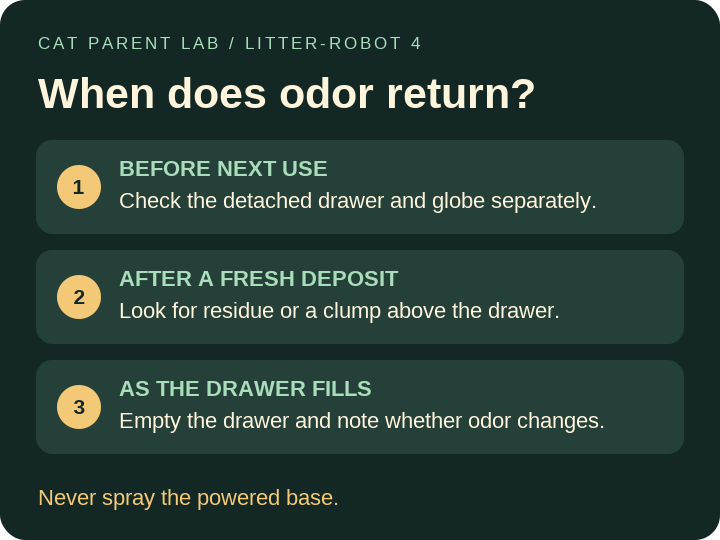
- Before the next use: Check the removed drawer and the globe separately while the unit is off and unplugged. If the smell seems strongest at the powered base after permitted cleaning, contact Whisker rather than spraying into its openings.
- After a fresh deposit: Once the cat has left and the unit is stationary, look for residue on the globe wall or a clump that stayed above the drawer.
- As the drawer fills: Record whether emptying the drawer changes the smell before you change litter or replace parts.
What seven households noticed
- In November 2024, one household noticed the same smell in a new disposable pan with the same litter after a deep clean of its replacement LR4 had failed to clear the smell.
- In February 2026, a two-cat household still noticed odor right after urine hit the globe liner and found clumps stuck above the bin despite weekly liner cleaning and a recent deep clean.
- In March 2026, another two-cat household reported that the unit smelled before either cat had used it after the second deep clean in a week.
- In August 2026, an owner of four LR4 units reported that only one smelled three days after a deep clean.
- On August 1, 2026, an owner of a three-year-old LR4 reported that odor returned in under twelve hours after cleaning, replacing the liner, and changing the carbon filters; those simultaneous changes do not isolate a cause.
- On September 29, 2026, a two-cat household reported that persistent odor cleared after replacing the globe liner and seal strips while deep-cleaning the globe, so the report cannot tell which change mattered.
- On October 9, 2026, a one-cat household reported continuing odor after two deep cleans in about a month, weekly carbon-filter changes, and twice-weekly waste removal; the post did not report a successful fix.
The February and March accounts put the odor on opposite sides of the first post-clean use, so repeating the same wash would skip a useful observation. The disposable-pan comparison makes a cause unique to the machine less likely in that home, but it cannot separate the litter from the cats' waste. The four-unit account makes a side-by-side check useful; it does not show that all four machines got equal use or that a part needed replacing. The August, September, and October reports put a quick return, a reported improvement, and persistent odor side by side; they do not establish a universal cleaning or replacement fix.
For a further clean, follow Whisker's Litter-Robot 4 deep-cleaning instructions; the household comparisons above cannot identify which part caused an odor or establish a new cleaning frequency.
Watch the Litter-Robot 4 odor-check Short.
For a standard open litter pan, see the non-automatic cleaning routine; its water-cleaning steps do not apply to a powered base.
Evidence not found: A named, dated firsthand cleaning record and measured comparison of cleaning results were not found. This guide must not be read as an experiment performed by CatParentLab.