How to Train a Cat to Use a Litter Box: Start with Access, Then Adjust
To help a cat learn the litter box, make an easy-entry box calm and reachable, offer quiet chances after waking or meals, and change one setup detail at a time. Start with access and a familiar setup; if the first approach fails, use the sequence below to identify what changed and what the cat actually did. A sudden change in a cat’s bathroom habits can have a medical cause, so do not treat every refusal as a training problem.
Start here
Make access easy → offer a familiar box → observe without pressure → record the attempt and result → adjust one thing.
Four dated experiences, compared
The dates are when each account was reported, not necessarily when training began. Each row is one person's account. The outcomes are reports, not controlled tests, so a change that came before success does not prove it caused the success.
| Report date | Cat and starting situation | What was tried | Reported result and limit |
|---|---|---|---|
| 2024-02-21 | 10-week-old kitten; repeated placement after meals, sleep, or drinking had not worked. | The caregiver put paper carrying the kitten’s urine scent in the tray. | The caregiver reported both urination and defecation in the tray by the third day. This is one kitten’s timeline, not a promised training period. |
| 2022-06-15; update 2022-06-18 | 8-week-old kitten rejected pine pellets and ate clumping clay. | The caregiver changed litter and tray location, then also added attractant and showed an instructional video. | The caregiver reported two uses within 12 hours. Several things changed, so the account cannot isolate which change mattered. |
| 2023-05-25 | A young found kitten repeatedly chose the space under a dresser. | Putting waste in the tray and moving the kitten’s paws did not help; the caregiver then modeled digging by hand. | The caregiver reported immediate tray use and no further problem. That is one reported outcome, not a repeatable promise. |
| 2023-05-25 | Another caregiver described a kitten estimated at about 6 weeks old. | The caregiver placed the kitten in the tray and moved its paws. | The kitten began entering, but the caregiver still needed to stay nearby during elimination for about a month. Initial entry did not mean the process was finished. |
Retraining after a move: identify the change that came just before refusal
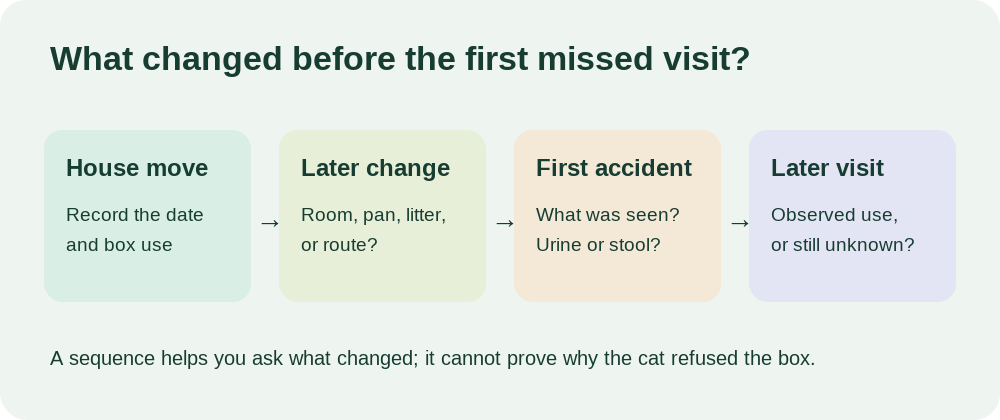
If a previously trained cat stops using the box after a move, keep an accessible familiar box available and arrange a veterinary check; record which change came just before the first accident. A move, a replacement pan, a different litter, and a second move of the pan are separate changes. The timing can help you choose one setup variable to restore, but it cannot diagnose the cat or prove a single cause. The FelineVMA house-soiling guide calls for medical evaluation when house-soiling starts and for checking the box, litter, location, and access.
| Report and household | Change and observed sequence | What this account cannot prove |
|---|---|---|
| September 2, 2024; a two-cat home with a young blind cat. | The cats used a bathroom box after the house move. After the owner moved it beside a cat flap, one cat eliminated beside it; a second box with different litter helped briefly, but accidents returned. | The room, route, extra box, and litter changed. The post also mentions stool changes, so it cannot identify one cause or show a lasting fix. |
| January 24, 2025; a cat that had used its box in the previous apartment. | After the move, the owner removed the box door and thought the problem had stopped, then found stool buried in a houseplant. | Not finding an accident in the usual spot did not establish recovery. The post does not report a completed retraining outcome. |
| January 25, 2025; a newly moved cat whose box was relocated within the new home. | The owner reported a floor accident after moving the box, then returned it to its previous spot and planned to wait before trying again. | The thread records the restoration, not whether subsequent visits succeeded; it cannot set a safe relocation speed for other cats. |
| June 7, 2025; a four-year-old cat. | Box use was reported as normal for six weeks after the house move. Problems began after the box was moved from the bathroom to an under-stairs room and continued even when it went back. | The later box move is a clearer timing marker than the house move, but the post does not establish causation or a successful remedy. |
| July 31, 2025; a seven-year-old cat in a new apartment. | The familiar covered box was replaced during the move. A cardboard cover and several new placements did not initially restore use; the owner later reported that the cat took about a week to use the new box. | Several changes and elapsed time overlap. This account does not prove the cover, a specific location, or waiting caused the later use. |
Practical inference from these reports: write down the house move, each later box or litter change, the first missed visit, and whether a complete later visit was actually seen. If the cat had used the box after moving and only stopped after a second change, do not collapse those events into “the move caused it.” Preserve a usable accepted option while discussing new or persistent house-soiling with a veterinarian; the reports do not replace that assessment.
How long does it take to retrain a cat to use a litter box?
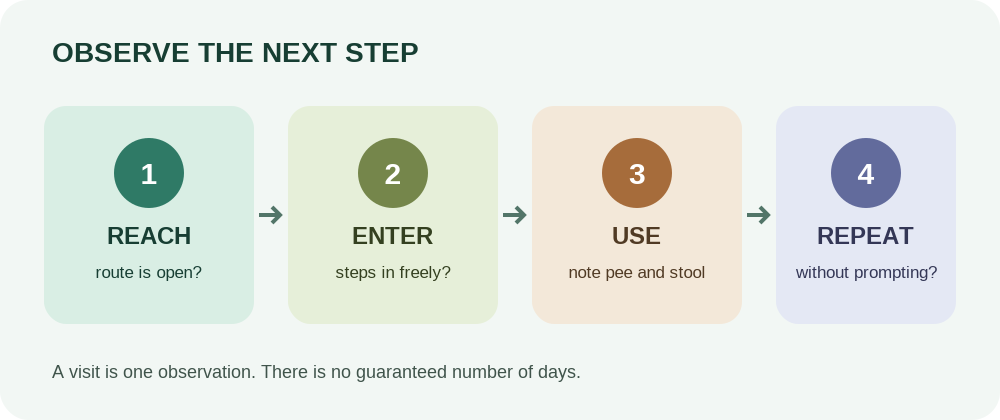
There is no verified deadline for a particular cat: look for a complete box visit and then a repeated unprompted visit rather than counting days from the house move. One July 2025 household reported use after about a week, while the June 2025 household still reported accidents after restoring the old location. Neither account sets a general timetable, and persistent or new house-soiling still needs veterinary assessment under the FelineVMA guidance.
Track the next step, not a day count
A kitten can enter a tray without yet using it independently, and one successful visit does not show whether the routine will repeat. Record the observable steps separately: reach the box, enter, dig or position, urinate or defecate, then return on a later opportunity without being placed there. The four accounts above include both a reported use after a changed cue and a kitten that still needed a person nearby after beginning to enter; they do not establish a standard schedule.
Use one calm sequence; branch only when a step fails
- Check access first. Keep the route open and the entrance manageable for this cat. If the cat is small, older, or has limited movement, a low side can remove a physical barrier. If another animal can block or startle the cat, provide a safer route or separate option.
- Keep the first offer familiar. Use a clean, accessible tray and a litter the cat has accepted before when possible. If a new texture or location is part of the problem, preserve the familiar option while testing one change; do not change litter, tray, and room all at once if you need to learn which factor mattered.
- Offer a chance; do not force a result. After waking or eating, make the route available and give the cat room to investigate. If the cat resists being carried or placed in the tray, stop and make the setup easier instead of holding the cat there.
- Record the sequence. Note the date, the kitten’s age, the box setup, what happened before the opportunity, which checkpoint the kitten reached, and whether the next visit happened without prompting. If several details changed together, record them together and do not credit one as the cause.
- Respond to accidents without punishment. Clean the spot thoroughly with a product labeled for pet urine and follow its directions. Avoid scolding or startling the cat; note whether the accident happened beside the tray, behind a barrier, or in a preferred corner.
Evidence boundary: these accounts show different sequences and outcomes, but they do not establish that scent transfer, changing litter, modeling digging, or staying nearby will work for another cat. Treat each as a possible observation to discuss with a veterinarian or test cautiously—not as a universal method or deadline.
When refusal needs a health check
A sudden change in box use, repeated straining, blood, signs of pain, or frequent attempts with little urine should not be handled as a training failure. Contact a veterinarian promptly; inability to pass urine is urgent. This page cannot determine the cause of a cat’s symptoms.
Kitten litter box training: track the setup, not a deadline
For “how to litter train a kitten” and “how to train a kitten to use a litter box,” begin with a small, reachable tray, a calm route, and an unhurried chance to use it. Avoid setting a fixed age or number of days for success; kittens and their environments differ.
When progress is uneven, record what happened before a visit or accident: the location, whether the route was blocked, the box condition, and any recent litter or room change. For help choosing a material before training, see our litter guide for kittens. Sudden changes, pain, straining, or little to no urine call for veterinary care rather than more training attempts.
Download the kitten litter-box training log (CSV)
For a cat who has started urinating outside the box, see how to assess a cat peeing outside the litter box.