Where can I put a litter box so my cat can reach it easily?
Place the litter box in a quiet, low-traffic spot away from food and water, with a clear exit and a view of the doorway. Treat the doorway view as a practical sightline check, not a veterinary rule: the guidance supports a usable escape route, while the exact orientation depends on the room and the cat.
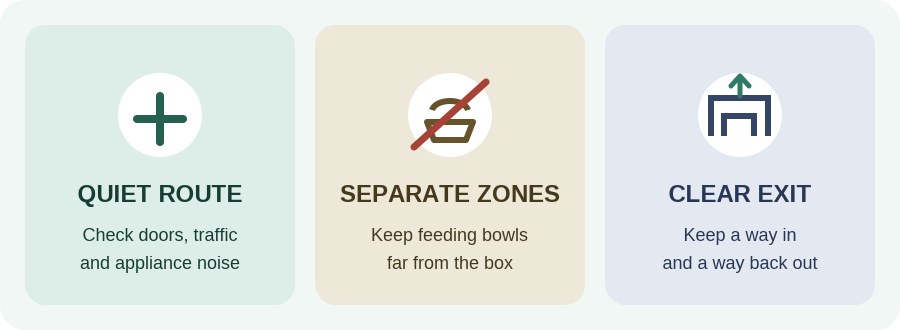
Check these conditions before choosing a room
- Keep access dependable. Check the route with household doors in their normal positions. A room is not available if a door closes, stored items narrow the path, or another animal can block the only entrance.
- Separate the box from feeding. Cornell’s new-cat guidance says food and water dishes should be kept far from the litter box. Use the layout to create distinct feeding and toileting areas rather than placing them side by side.
- Check noise during ordinary routines. Listen when appliances run and people pass through. AAHA/AAFP guidance identifies loud appliances and high-traffic routes as factors to consider; a quiet moment during setup is not enough.
- Leave a usable way out. Avoid a dead-end position where a cat can be surprised or trapped. AAHA/AAFP guidance recommends a location with an escape route. A view toward a doorway may help you inspect the sightline, but it is a layout check, not a prescribed orientation.
- In a multi-cat home, check each approach. The AAHA/AAFP rule of thumb is one box per cat plus one, or one per social group plus one. Place them so one narrow passage does not control access to every box.
Where should I put a Litter-Robot?
For a Litter-Robot 4, use the old box’s location during transition if possible, then place it indoors on a firm, level surface in a cool, dry spot near an outlet. Keep the unit from touching a wall or sitting in a corner, and avoid direct sunlight when possible. These are Whisker’s Litter-Robot 4 placement instructions, not universal rules for every automatic box; see the Litter-Robot 4 manual’s placement section for the model-specific setup.
Six dated moves, six household outcomes
These are individual household observations, not controlled tests. Each row records the household conditions, the location change, and what the owner reported afterward; it does not establish why a cat behaved that way.
| Date | Starting conditions | What changed | Reported result |
|---|---|---|---|
| June 22, 2026 | Two four-month-old male kittens used a box in a bedroom. | The box was moved just outside the bedroom after they had used it there. | One kitten used the new location; the other urinated on the bed. The owner moved the box back. |
| June 8, 2026 | Two cats had moved to a larger home and started in a familiar safe room. | After a day of exploring, the box was moved to the basement. | One cat used it right away. The other went only when carried and had one elimination upstairs. |
| May 28, 2024 | A four-year-old cat had recently flown across the country; the same open box and litter were moved from a guest bathroom to beneath the stairs. | The owner cleaned a rug after stool appeared there. | The cat later urinated on that rug. The report does not establish the reason. |
| May 8, 2025 | Two newly adopted cats had started with a box upstairs. | The owner moved the box gradually from the basement toward the stairs, landing, and upstairs hall over about a week. | After it reached the hall, the cats defecated on a couch; one mostly stayed in the living room while the other explored. |
| August 26, 2026 | A 10-month-old female cat had been using a box on a stair landing. | The owner moved it about 10 feet into the basement. | The owner reported much less urine and stool in the box between cleanings, but had not found waste elsewhere. The report does not show whether the change came from the new location. |
| September 11, 2026 | Two cats moved to a ranch-style home with a finished basement; boxes were available on both floors. | The household added access to the basement box after the move. | The owner reported that both cats used only the main-floor box. The owner suspected they spent less time downstairs, but that explanation was not tested. |
Read the result cat by cat
Inference from the six dated reports: a move that works for one cat can fail for another, including cats sharing the same home. The reports do not show that a gradual move guarantees acceptance or that a single accident identifies the cause. Keep the familiar location available when practical, record which cat used which box, and change one placement condition at a time so the next observation is interpretable.
A published AAFP/ISFM house-soiling guideline gives a useful stopping point when a box has been placed at a new site: after the cat begins using it there, leave it in that same place for at least two weeks. Move it gradually only after use has become consistent. This is guidance for house-soiling cases, not a guarantee that every cat will accept a move on that schedule.
Use a simple log: date and time; which cat; old and new location; doors, noise, and access conditions; then the observed result. Do not turn one household’s result into a fixed transition schedule for every cat.
If a cat suddenly stops using a familiar box, strains, or shows another abrupt toileting change, contact a veterinarian. A location check cannot rule out a medical problem; see Cornell’s house-soiling guidance.
Can litter boxes go on different floors?
Yes—keep a box on each floor the cats use, and place boxes so one cat cannot control the only route to them. The Feline Veterinary Medical Association’s 2026 toolkit recommends different locations and at least one box per floor to support entry and exit and reduce blocking by another cat or species. In one dated two-cat move, both cats used the main-floor box while leaving the basement box unused; another owner reported a change in box deposits after moving one about 10 feet from a stair landing to the basement. Those accounts show why access and actual use need separate notes, but they do not prove that floor or distance caused either outcome. If a cat’s output changes, do not assume placement is the cause; discuss a sudden change with a veterinarian.
A quick placement check
- Walk the path while doors and appliances are in their usual state.
- Confirm food and water are in a separate area.
- Look for a clear approach and exit, including for each cat in a multi-cat home.
- Write down the setup and each cat’s response before changing another condition.
For a separate step-by-step introduction routine, read the kitten litter-box training guide.
Evidence not found: A named, dated household trial comparing litter-box locations was not found. The placement checklist and dated retailer snapshot do not measure a cat's preference or accident rate.